Draft 1
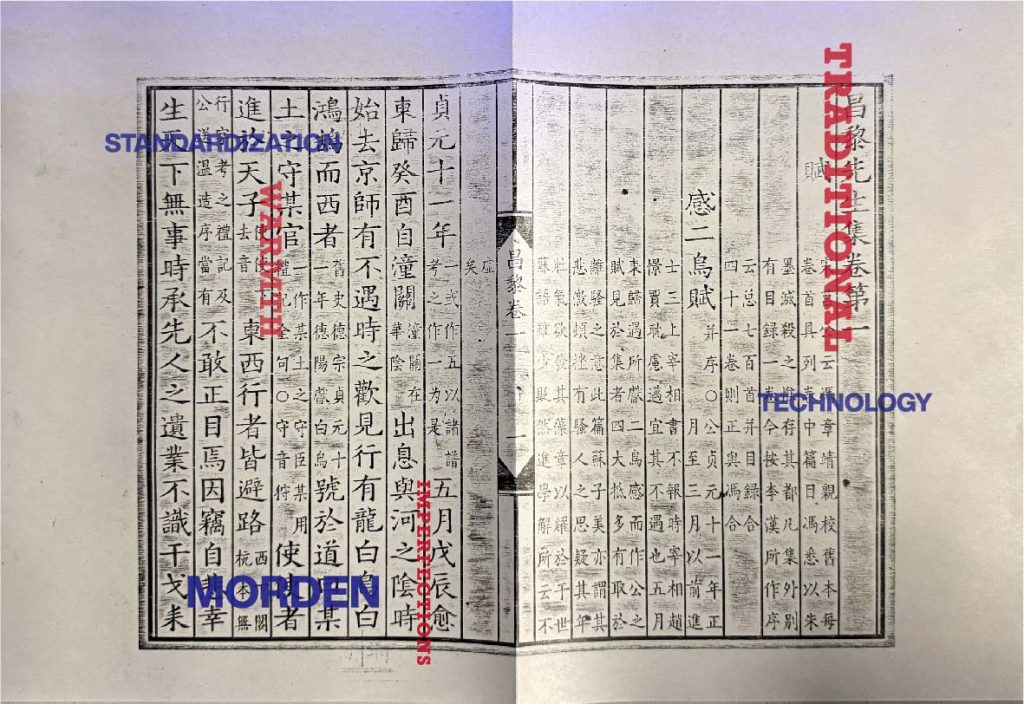
As a designer major in digital media art for my bachelor’s degree, I am exploring the use of woodblock printing to create interior pages of ancient Chinese books. However, it is difficult to make woodblock by hand in a short period of time, so I decided to create a 3D model and use 3D printing to make woodblocks. During the process, I discovered many differences in the ancient and modern Chinese typography, such as the direction of text arrangement, the use of simplified and traditional Chinese characters, and the selection of fonts.
The most interesting thing to me is the lack of punctuation marks in the ancient Chinese typography, making it very difficult for even native Chinese speakers to read such texts. This is equivalent to removing spaces and punctuation marks from English texts. This reading logic has shown me the boundaries of text readability. In addition, it allows me to personally experience that the barriers between media and materials have been broken down, and the traditional handmade woodblocks are no longer limited to only experienced craftsmen, while production has greatly increased. It can be said that the development of technology has greatly lowered the threshold for mastering new media, while also accelerating the transmission and dissemination of information.
Although the media and reading logic used at that time are rarely used today, the craftsmanship and aesthetics left behind can still be interpreted through digital design.
Draft 2
After discussing with the workshop staff, due to size limitations, I had to give up 3D printing and instead use laser cutting to create woodblocks and replicate the inner pages of rare Chinese books. Throughout this process, I experienced the fusion of traditional craftsmanship and modern technology, which led me to reflect on the following questions: How does modern technology influence our understanding and reproduction of traditional culture? Does the intervention of technology alter the value and significance of the original work?
In The Medium is the Massage, Marshall McLuhan argues that media itself profoundly impacts human perception and social structures, often exceeding the influence of the content it conveys. He emphasizes that the form and characteristics of a medium “massage” our senses, shaping our ways of understanding the world.
In my project, laser cutting, as a modern medium, is not only a tool for replication—but also subtly affects our perception of ancient books. Traditional woodblock printing requires skilled artisans to carve each detail by hand, embedding their craftsmanship into the work and endowing it with unique artistic value and historical traces. In contrast, the high precision and standardization of laser cutting enhance replication efficiency but may strip away the warmth and individuality associated with handcrafted woodblocks.
Therefore, in the next phase of my project, I plan to adopt an iterative approach, introducing elements of “randomness” or “human intervention” into the process to mimic the imperfections of hand carving. This exploration aims to find a balance between the efficiency of modern technology and the uniqueness of traditional craftsmanship. It is not only a form of “hacking” technology but also a practical validation of McLuhan’s theory of “the medium is the massage.”Through this approach, I hope to gain a deeper understanding of the role of modern technology in cultural heritage and explore ways to innovate and develop new techniques while preserving the essence of traditional culture.
Draft 3
Reference:
Mcluhan, M., & Fiore, Q. (1967). The Medium is the Massage: An Inventory of Effects. Berkeley: Gingko Press
Leave a Reply